- English
- Español
- Português
- русский
- Français
- 日本語
- Deutsch
- tiếng Việt
- Italiano
- Nederlands
- ภาษาไทย
- Polski
- 한국어
- Svenska
- magyar
- Malay
- বাংলা ভাষার
- Dansk
- Suomi
- हिन्दी
- Pilipino
- Türkçe
- Gaeilge
- العربية
- Indonesia
- Norsk
- تمل
- český
- ελληνικά
- український
- Javanese
- فارسی
- தமிழ்
- తెలుగు
- नेपाली
- Burmese
- български
- ລາວ
- Latine
- Қазақша
- Euskal
- Azərbaycan
- Slovenský jazyk
- Македонски
- Lietuvos
- Eesti Keel
- Română
- Slovenski

How CNC Thread Rolling Machines Improve Thread Quality and Production Efficiency
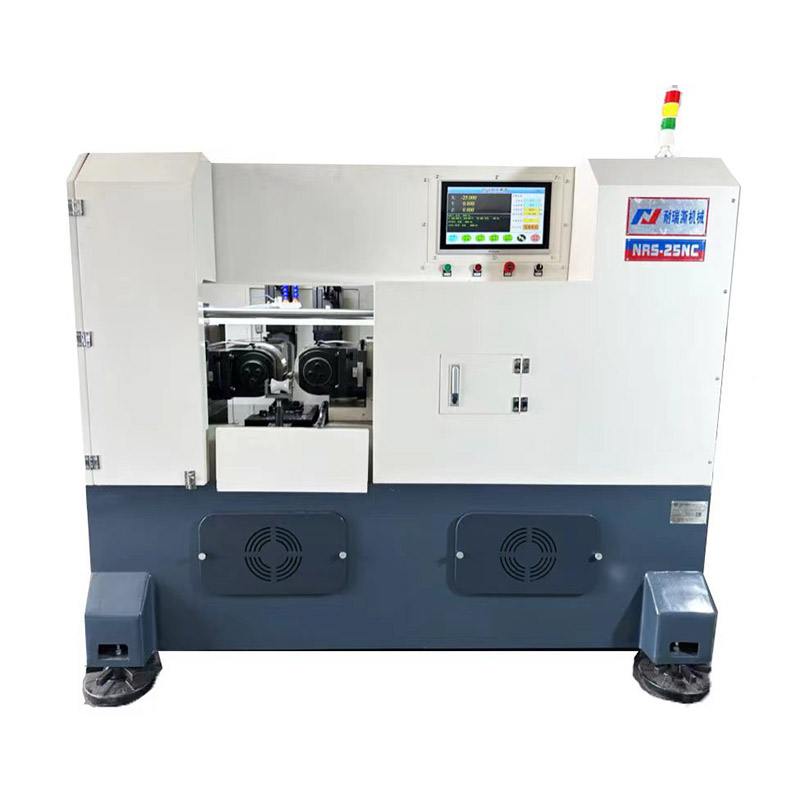
CNC thread rolling machines can improve thread consistency, production efficiency, and material utilization when the machine, rolling dies, workpiece material, and feeding system are correctly matched. Based on our experience at Dongguan Neres Hardware Machinery Co., Ltd. (NERES), thread rolling is particularly suitable for bolts, screws, fasteners, threaded rods, hollow pipes, and other components that require repeatable thread dimensions and stable high-volume production.
Contents
- How CNC Thread Rolling Improves Thread Quality
- How CNC Thread Rolling Improves Production Efficiency
- Why Thread Rolling Dies Matter
- Applications of CNC Thread Rolling Machines
- Thread Rolling vs. Traditional Thread Cutting
- Why We Use CNC Thread Rolling Technology at NERES
- FAQ
How CNC Thread Rolling Improves Thread Quality
When we evaluate a thread rolling process, thread quality is not determined by the machine alone. We normally look at the workpiece material, blank diameter, thread specification, rolling method, rolling dies, machine accuracy, and feeding consistency together.
A CNC thread rolling machine forms the thread by applying controlled pressure through hardened thread rolling dies. Instead of removing material with a cutting tool, the material is displaced and formed into the required thread profile.
For suitable materials and applications, this forming process can provide a more consistent thread profile and surface finish, especially when the same parts need to be produced repeatedly.
| Quality Factor | Effect of Thread Rolling | What We Check in Production |
|---|---|---|
| Thread profile | Material is formed against the die profile | Die profile, workpiece diameter and alignment |
| Thread consistency | Repeatable forming conditions support batch consistency | Machine setup, feeding and rolling parameters |
| Surface condition | Suitable rolling can produce a smooth formed thread surface | Material, die condition and lubrication |
| Dimensional accuracy | Controlled die geometry helps maintain thread dimensions | Blank size, die accuracy and measurement results |
How CNC Thread Rolling Machines Improve Production Efficiency
For us, production efficiency means more than simply increasing machine speed. A machine is only efficient if it can maintain stable quality while reducing manual handling, setup problems, rejected parts and unnecessary material loss.
Our CNC thread rolling machines can be configured with automatic feeding devices. This is particularly useful for repetitive production of bolts, screws, fasteners and threaded rods, where manual loading can become a significant part of the total production time.
Depending on the component and required thread form, our equipment can process parts using radial or axial rolling methods. With the appropriate rolling wheel and tooling, we can process standard bolts as well as specially designed bolts and tie rods.
1. Automatic Feeding Reduces Manual Handling
For high-volume production, feeding consistency directly affects production stability. An automatic feeder can continuously supply workpieces to the thread rolling machine, reducing the need for an operator to load each part individually.
We also manufacture automatic feeders for thread rolling machines and grinders. When the feeding system is properly matched with the machine and workpiece geometry, it can help reduce idle time and make the production process easier to manage.
2. CNC Control Helps Maintain Repeatable Processing Conditions
CNC control is useful when the same thread specification needs to be reproduced across a large batch. Once the correct parameters and tooling have been established, the operator can maintain a more consistent processing routine instead of relying entirely on manual adjustment.
In practical production, we still recommend checking the first pieces and monitoring the process rather than assuming that CNC control alone guarantees quality. Tool wear, material variation and incorrect blank dimensions can still affect the finished thread.
3. Thread Rolling Can Reduce Material Waste
Thread rolling forms the thread by displacing material rather than cutting away a large amount of material. For suitable workpieces, this can improve material utilization compared with machining processes that remove material to create the thread.
This becomes more relevant when manufacturing large quantities of fasteners or threaded components, because even a small reduction in material loss can become significant over a long production run.
Why Thread Rolling Dies Matter
In our experience, the rolling die is one of the most important factors in determining the final thread result. A high-quality machine cannot compensate for an incorrectly designed or worn die.
At NERES, we independently process and manufacture different types of thread rolling dies and embossing dies. Our tooling range covers different thread profiles and applications, including:
- Standard triangular threads
- MJ aviation threads
- Worm threads
- Trapezoidal threads
- Splines
- Straight threads
- Reticulated profiles
- Cruciform profiles
- PT threads
- NPT pipe threads
We normally select the die according to the thread specification, workpiece geometry, material and required rolling method. For special components, tooling development is often more important than simply selecting a larger or faster machine.
Applications of CNC Thread Rolling Machines
CNC thread rolling is commonly used where manufacturers need repeatable threads across large numbers of components. At NERES, our machines and tooling are used for applications including fastener manufacturing, automotive components, aerospace-related parts and other industrial components.
| Application | Typical Components | Key Requirement |
|---|---|---|
| Fastener production | Bolts, screws, threaded rods | Stable thread dimensions and repeatability |
| Automotive parts | Special bolts and threaded components | Consistent production and suitable tooling |
| Aerospace-related manufacturing | Specialized threaded components | Accurate thread profile and controlled processing |
| Hollow components | Hollow pipes and tubular parts | Suitable three-axis rolling equipment |
Thread Rolling vs. Traditional Thread Cutting
We do not consider thread rolling a universal replacement for thread cutting. The correct process depends on the material, component geometry, thread specification, production volume and required tolerances.
| Factor | Thread Rolling | Thread Cutting |
|---|---|---|
| Material removal | Forms thread by material displacement | Removes material to create the thread |
| Production volume | Well suited to repetitive, high-volume production | Can be suitable for low-volume or flexible machining |
| Tooling | Requires application-specific rolling dies | Uses cutting tools or thread-forming tools |
| Material suitability | Depends strongly on material ductility and workpiece design | Can accommodate a wider range of machining conditions |
| Production consistency | Highly repeatable when machine, die and blank are correctly matched | Depends on cutting parameters, tooling and machine condition |
For a manufacturer producing thousands or more similar threaded components, we normally recommend evaluating thread rolling because the potential gains in throughput and material utilization can justify the investment in dedicated tooling and equipment.
Why We Use CNC Thread Rolling Technology at NERES
Dongguan Neres Hardware Machinery Co., Ltd. (NERES) is a manufacturer and supplier in Chang'an Town, Dongguan, Guangdong, China. We focus on thread rolling machines, thread rolling dies, thread rolling machine components and related thread processing equipment.
Our equipment range includes high-precision CNC thread rolling machines, hydraulic thread rolling machines, mechanical two-axis thread rolling machines, three-axis thread rolling machines for hollow pipes and small two-axis thread rollers. We also develop automatic feeding equipment for thread rollers and grinders.
Machine selection is not something we recommend doing only from a catalog. Before suggesting a model, our technical team normally needs to understand the workpiece, thread specification, material, production quantity, rolling method and required automation level. This helps us determine whether a standard machine is suitable or whether a customized configuration is needed.
We also maintain equipment for precision measurement and processing, including REISHAUER thread grinding equipment, grinding and hobbing equipment, CNC lathes, a Swiss White Horse projector and a Japanese Mitutoyo three-dimensional measuring system. These capabilities support our work in machine manufacturing as well as thread rolling die production.
For customers who need technical support after installation, our professional technicians can assist with machine operation, tooling selection and production-related problems. We also provide ongoing technical and after-sales support.
If you are evaluating a CNC thread rolling machine for bolts, screws, fasteners, threaded rods or other industrial components, you can send us the workpiece drawing, material, thread specification and expected production volume. We can then discuss the appropriate machine type, rolling method, tooling and automatic feeding configuration.
FAQ
What is a CNC thread rolling machine used for?
A CNC thread rolling machine is used to form external threads on components such as bolts, screws, fasteners and threaded rods. With suitable rolling dies, it can also process special thread profiles and other forms such as splines.
Does thread rolling improve thread quality?
For suitable materials and correctly designed tooling, thread rolling can provide consistent thread profiles and good surface conditions. The actual result depends on the material, blank diameter, die accuracy, machine setup and rolling parameters.
Can CNC thread rolling machines process hollow pipes?
Yes. NERES manufactures a three-axis thread rolling machine specifically for hollow pipe applications. The machine configuration should be selected according to the pipe dimensions, material and thread requirements.
Can the machine be equipped with an automatic feeder?
Yes. Our CNC thread rolling machines can be equipped with automatic feeding devices. Automatic feeding is particularly useful for repetitive production because it reduces manual loading and helps maintain a continuous production cycle.
How do I choose the right CNC thread rolling machine?
We recommend starting with the workpiece rather than the machine model. Important information includes material, outside diameter, thread type, thread length, part shape, production volume, required accuracy and whether automatic feeding is required. Based on these details, the suitable machine type, rolling method and dies can be determined.
Does NERES manufacture thread rolling dies?
Yes. NERES independently produces different types of thread rolling dies and embossing dies, including dies for triangular, MJ aviation, worm, trapezoidal, spline, PT and NPT thread profiles.